Nepal has four UNESCO World Heritage Sites. Most tour brochures claim ten, which is technically counting the Kathmandu Valley as seven separate sites — they’re not. Officially, by the UNESCO register, Nepal has four: the Kathmandu Valley cultural property (which contains seven monument zones), Sagarmatha National Park, Chitwan National Park, and Lumbini. Between them they cover the country’s ancient architecture, its highest mountains, its biggest jungles, and the actual birthplace of the Buddha.
This is the overview — what each site is, why UNESCO listed it, what’s worth seeing, and how they connect into a trip. For the deep dive on any individual site, we’ve got separate guides linked throughout.
In This Article
The four UNESCO sites of Nepal
| Site | Type | Listed | Region |
|---|---|---|---|
| Kathmandu Valley | Cultural | 1979 | Kathmandu, Patan, Bhaktapur |
| Sagarmatha National Park | Natural | 1979 | Everest region, Khumbu |
| Chitwan National Park | Natural | 1984 | Central Terai |
| Lumbini | Cultural | 1997 | Rupandehi, Western Terai |
The two natural sites were listed under UNESCO’s “outstanding universal value for natural heritage” criteria — Sagarmatha for the highest peaks on earth, Chitwan for the subtropical inner-Terai ecosystem with its one-horned rhinos and tigers. The two cultural sites were listed under cultural criteria i-iv: architecture, urban planning, spiritual significance.
Kathmandu Valley — the seven-monument site
The Kathmandu Valley is listed as a single World Heritage property covering seven specific monument zones. UNESCO’s concern is less with “the valley” as a geographical unit and more with the concentration of temple complexes, stupas, and palace squares from the Malla era (12th-18th century) that survived into the modern city.
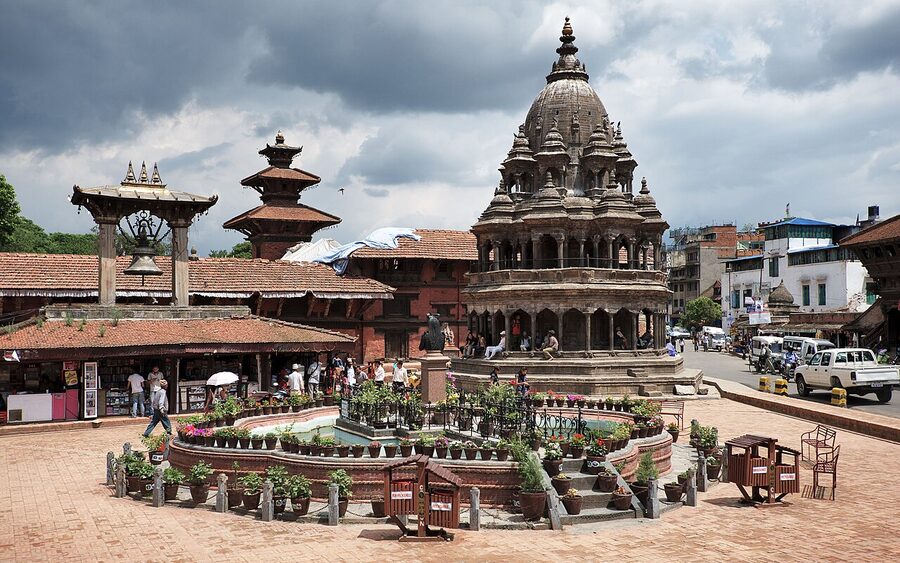
The seven monument zones are:
- Hanuman Dhoka Durbar Square — the royal plaza in the heart of old Kathmandu, dating from the 12th century, with a concentration of pagoda-style temples that took serious earthquake damage in 2015 and are still being restored.
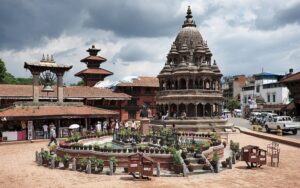
- Patan Durbar Square — the second royal plaza, 5 km south across the Bagmati in Lalitpur. The best-preserved of the three squares, with the Krishna Mandir (1637) and the Bhimsen temple as standout pieces.
- Bhaktapur Durbar Square — the eastern kingdom’s royal plaza, inside a walled medieval town that feels like a different century entirely. The five-tiered Nyatapola Temple at the edge of the square is one of the most photographed buildings in Nepal.
- Swayambhunath Stupa — the “Monkey Temple” on a hilltop west of the city. 4th-century, though the current structure is mostly Licchavi-period with Malla additions. The painted eyes on the central spire are Nepal’s most recognisable image.
- Boudhanath Stupa — the largest stupa in Nepal, a 36 m dome on a walled kora path in the eastern suburbs. Tibetan Buddhist pilgrims walk the circumference clockwise from dawn to dusk.
- Pashupatinath Temple — Nepal’s holiest Hindu temple, a riverside complex on the Bagmati dedicated to Shiva. Non-Hindus aren’t allowed inside the main shrine but the cremation ghats and surrounding monastic complex are visible from the east bank.
- Changu Narayan Temple — the oldest confirmed temple in Nepal (4th-century inscription, structure 15th-century), on a hilltop 22 km east of the city. Often skipped by tourists on a short schedule. Worth the trip if you’ve got half a day.
You can’t do all seven in a day, despite what the Marriott-branded tours promise. Two days, carefully planned, will get you through the core five (three Durbar Squares, Boudhanath, Swayambhunath). A full week gets the whole complex properly. For a practical walking plan, see our Kathmandu travel guide.
Entry fees per monument zone range from NPR 200 to NPR 1,800 (see the Kathmandu guide for current per-site pricing). The foreigner-pricing tier is substantially higher than Nepali pricing, and you’ll pay separately at each zone — there’s no combined ticket.
Sagarmatha National Park — the high altitude site
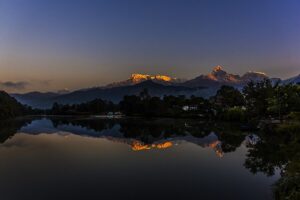
Sagarmatha was one of UNESCO’s first natural heritage listings in South Asia, added in 1979 on the strength of three things: Mount Everest at 8,849 m, the Sherpa cultural landscape, and a glacial ecosystem that UNESCO explicitly called “aesthetically important” (which is bureaucratic language for “spectacularly beautiful”).
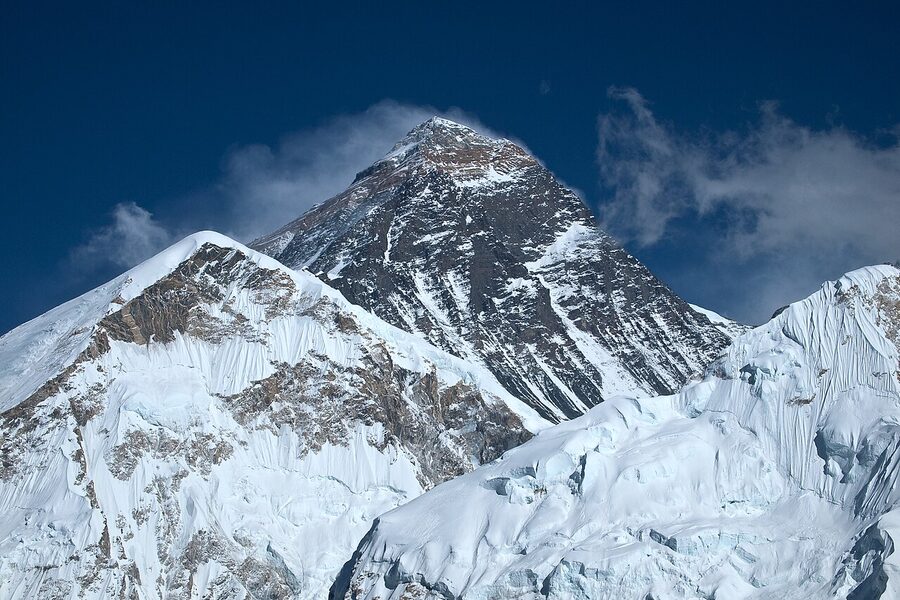
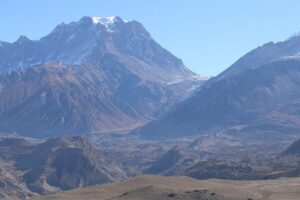
The park covers 1,148 km² around Everest, reached almost exclusively by flying to Lukla and trekking in. The UNESCO listing mentions not just Everest but Lhotse (8,516 m), Nuptse, Ama Dablam, and Cho Oyu — plus five glaciers, the Sherpa cultural villages of Namche Bazaar and Tengboche, and the Chomolungma Buddhist monasteries.
Visiting: entry fee NPR 3,000 ($25) for foreigners at the Monjo park post. Most people come on a Lukla-Namche-Tengboche-Gorak Shep trek (the standard 12-14 day EBC itinerary). Short of trekking, the Everest “Mountain Flight” from Kathmandu — a 1-hour scenic loop at 6,700 m — gets you across the park by air without landing.
For the full breakdown of what Sagarmatha looks like on the ground and how to access it, see our Nepal national parks guide.
Chitwan National Park — the natural-value site
Chitwan was Nepal’s first national park (1973) and became the country’s second UNESCO natural heritage property in 1984. The listing was specifically for the sub-tropical inner-Terai ecosystem — a habitat type that had nearly vanished across India by the mid-20th century — and for the wildlife it holds, most famously the greater one-horned rhinoceros.
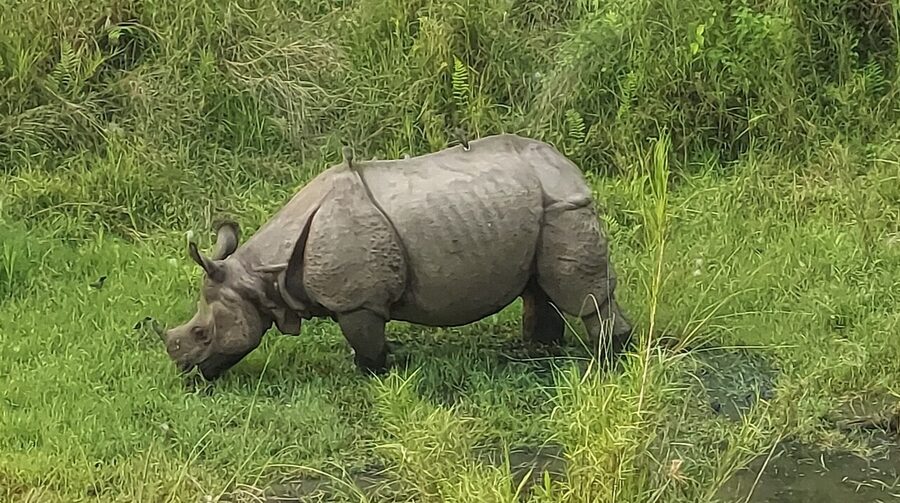
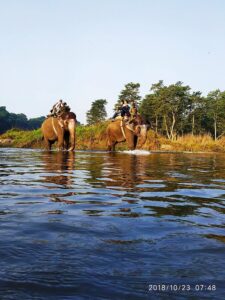
The park’s 952 km² sit between the Rapti and Narayani rivers. Besides rhinos (~750 in Chitwan specifically), the UNESCO criteria cited Bengal tigers (~120), gharial and mugger crocodiles, Asian elephants, Gangetic river dolphins, and over 500 bird species. The Tharu cultural landscape around the park’s edge is part of the buffer-zone management but not directly part of the UNESCO property.
Access from Kathmandu is a 25-minute flight to Bharatpur (then a 30-minute drive to Sauraha) or a 5-hour drive. Entry fee: NPR 2,000 ($15). Three nights is the sweet spot for a proper visit with jeep, canoe, and walking safaris.
Lumbini — the birthplace of the Buddha
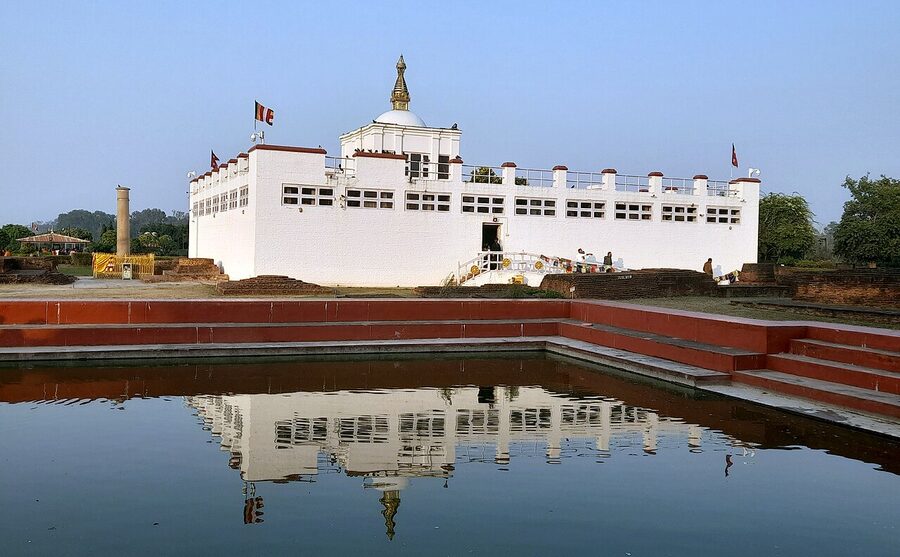
Lumbini is the smallest of Nepal’s UNESCO properties and the most singular in its meaning. The garden where Queen Maya Devi gave birth to Siddhartha Gautama — the man who became the Buddha — in 563 BCE. The Mayadevi Temple marks the exact spot; the Ashokan pillar next to it, inscribed by Emperor Ashoka in 249 BCE during his pilgrimage to the birthplace, is the archaeological evidence that anchors the site historically.
The UNESCO listing in 1997 covered the Mayadevi Temple, the Ashoka pillar, and the surrounding sacred garden and monastic zones. A master plan drafted by Kenzo Tange in 1978 gave the site its current layout: a 5 km-long rectangular garden with monasteries from dozens of Buddhist countries arranged in two zones (Theravada on the east, Mahayana on the west) around a central sacred pond. Walking through, you can visit the Thai monastery, the Korean, the Sri Lankan, the Vietnamese, the Japanese Peace Pagoda, and dozens more.
Access: fly from Kathmandu to Bhairawa (Gautam Buddha International Airport) in 35 minutes, then a 20-minute drive to Lumbini; or drive 8-9 hours from Kathmandu via Butwal. Entry fee: NPR 1,000. Most visitors spend a day; serious pilgrims stay for three or four.
Lumbini is unusual among UNESCO sites for being continuously active as a religious destination. It’s not a museum — it’s a pilgrimage centre, and the feel on the ground is closer to Varanasi than to, say, Pompeii.
Seeing all four in one trip
It’s feasible to see all four of Nepal’s UNESCO sites in a single 2-week trip, and plenty of visitors do it. A reasonable itinerary:
- Days 1-3: Kathmandu Valley — cover the three Durbar Squares plus Boudhanath, Swayambhunath, and Pashupatinath. Skip Changu Narayan unless you have specific interest.
- Days 4-6: Fly Kathmandu → Bharatpur → Chitwan. 3-night stay in Sauraha with jeep, canoe, and walking safaris.
- Days 7-8: Fly Bharatpur → Bhairawa (via Kathmandu connection) → Lumbini. Day 8 at Lumbini exploring the monastic zones.
- Days 9-14: Fly Bhairawa → Kathmandu → Lukla for the Everest Base Camp trek (6-day shortened EBC-lookout variant) or Sagarmatha scenic mountain flight plus an easy Langtang or Helambu trek.
The logistics are real. You’ll do eight internal flights and around 20 nights on the ground. It’s not cheap but it’s achievable. If you have less time, drop Lumbini first (smallest and most specialised), then Chitwan (you can see rhinos in Bardia instead), and prioritise Kathmandu + Sagarmatha.
The sites UNESCO hasn’t listed (yet)
Nepal has several “tentative list” properties that have been proposed for future UNESCO listing but haven’t made the cut yet:
- The Tilaurakot and Kapilavastu archaeological complex, near Lumbini — widely believed to be the kingdom where the Buddha grew up.
- The Cave architecture of Muktinath Valley in Upper Mustang — thousands of ancient cliff caves carved into the Kali Gandaki canyon walls.
- The Khumbu extension to connect Sagarmatha more explicitly with Rongbuk on the Tibet side.
None are listed yet. Several will probably get listings in the next decade. Mustang in particular is worth visiting partly because it’s on the UNESCO radar — the listing will bring more infrastructure and more visitors, which changes the character of the place.
Why the sites matter
World Heritage designation doesn’t add intrinsic value to the places it lists. Everest is Everest regardless of what UNESCO thinks about it. But the listing does three useful things for travellers: it flags what the international community considers Nepal’s standout cultural and natural properties, it channels conservation funding (Sagarmatha’s entry fees fund park maintenance, Lumbini’s fund excavations at Tilaurakot), and it signals that these are the places where the infrastructure — if imperfect — is at least set up to accommodate visitors.
All four of Nepal’s UNESCO sites are genuinely worth visiting, and together they map out the country’s range: urban, alpine, jungle, pilgrimage. Plan a trip that hits all four and you’ll have seen Nepal in the shapes it values most in itself.
For the practical planning of moving between them — flights, permits, costs — start with our airlines guide. For the deeper context on the natural sites, the national parks overview covers both Chitwan and Sagarmatha in more detail.