|
Nepal is the ?Land of
Festivals? with at least one part of the kingdom celebrating a festival
every day of the year. Festivals may be linked with the remembrance of
the departed soul, to herald a different season, to mark the beginning
or end of the agricultural cycle, to mark national events, or for
family celebrations. On a festival day the Nepalese take their ritual
bath, worship different gods and goddesses, visit the temple, observe
fasting and undertake feasting. The most important aspect of Nepalese
culture is the religious harmony and understanding prevailing among the
Hindus and Buddhists.
|
Festival Name
|
Description
|
|
Dashain: |
Celebrated in October, nationwide in
October.
The most important of all Nepalese
celebrations.
Features the biggest animal sacrifice of the
year. |
|
Tihar: |
Celebrates in November
Animals are
honoured. |
|
Holi: |
Celebrates in March.
|
|
Chaitra
Dashain: |
Celebrates in
April.
Animals are sacrifice.
|
|
Haribodhini
Ekadashi: |
Celebrates in November.
Celebrates in
Pashupatinath. |
|
Maha
Shivaratri: |
Celebrates in March.
Celebrates in Pashupatinath
|
|
Gai
Jatra: |
Held in August, Kathmandu.
|
|
Krishna
Jayanti: |
Held in August/September in
Patan.
|
|
Mani Rimdu:
|
Celebrates in November, Solu
Khumbu. |
|
Buddha
Jayanti |
Celebrates in May, Kathmandu.
|
|
Losar (Tibetan New
Year): |
Held in February, Swayambhunath, Jawlakhel and
highland
communities |
The rich cultural heritage of Nepal
is best expressed in the many large and small festivals that occur
throughout the year. Though the Nepalese have diverse beliefs and
ethnic background, all unite in the celebration of the year's major
festivals. There are many kinds of festivals: some honor certain Hindu
and Buddhist gods or goddesses, some recreate important events from
ancient mythology and epic literature, some herald the seasons or mark
important times in the agricultural calendar, and others propitiate the
minor deities that populated the spirit world of the
country.
Festivals such as Dashain and Tihar
are of national significance; some such as Bisket or Red Machhendranath
Jatra, belong to the traditions of the old Valley towns; and still
others, such as Mani Rimdu, are celebrated only in particular
countryside community. It has been said that in Nepal,
"every other building is a temple and every other day is a
festival & quot; Whatever time one visits Nepal, there is
certain to be a colorful and rewarding festive experience.
The annual dates for the festivals
were fixed long ago on specific days of the ancient lunar calendar.
Obviously these do not coincide with the solar calendar currently used
in Nepal, nor with Gregorian calendar. Calendars are printed each
spring at the beginning of the Nepalese year which show all three dates
- the lunar, the Nepalese and Gregorian. The Nepalis skip nimbly from
one to the next while Westerns flounder in confusion.
Thus, unless one is a learned
astrologer, possessed of mathematical genius, there is no way to
foretell the exact date for next year's
festivals.
The Nepalese Calendars:
The calendar question, in Nepal, is a little
complex. Indeed, in addition to the Western (Gregorian) calendar, which
is merely tolerated, there are four different 'time computers'.
a) The official
calendar, mandatory in all public acts and correspondence. It is called
"Vikram Sambat Era" comes from the name of
Vikramaditya, which started on Feb. 23re, 57 B.C. But the year begins
in Mid-April.
b) The Newar
community, in Kathmandu Valley in particular, are traditionally and
sentimentally attached to their own calendar which is, paradoxically,
called 'Nepal Era'. This Nepal Era started in 879-880 A.D. The year
begins on the festival called Tihar that takes place on the new moon
night of the month of Kartik (Oct./Nov.).
c) The third
calendar is the 'Sakya Era', which began in 77-78 A.D. under King Raja
Nanda Deva, a descendant of King Amsuvarma, the founder of the Licchavi
dynasty. This new era is said to have been introduced in commemoration
of Nanda Deva's access to the throne.
The Nepalese New Year's
Day: On this day a popular festival takes place
in the 3 rd city of Kathmandu valley Bhaktapur, where a gigantic pole
installed with two long flags hanged on the top will be laid down
(rooted out) in a great pomp and show. This will last for a week, many
chariots festivals of Gods and Goddesses will be celebrated with open
joys and cheers.
Red Machhendranath
Jatra (April) This festival is the biggest
socio-culture event of Patan. It begins with the chariot journeys of
the most widely venerated deity of the Nepal valley, who resides in his
twin shrines at Patan and Bungamati. His popular name is Bunga Deo, but
non Newars call him also by the name of Red Machhendranath. The wheeled
chariot is prepared at Pulchowk and pulled through the town of Patan in
several stages until several month later it reaches Jawalakhel for the
final celebration of this festival called the Bhoto ekhaune. The two
Machhendranath of Patan and Kathmandu form part of same cult of
Avalokiteswara in the Mahayan religion.
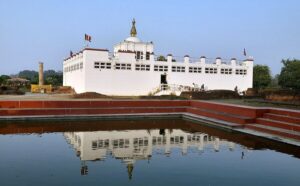
Buddha Jayanti (May)
This day which falls on the full moon of the
month of Baisakh is celebrated to commemorate the birth attainment of
enlightenment and the death of Gautam Buddha, the founder preacher of
Buddhism, more that 2500 years ago. Prayers are sung and worship is
offered by the Buddhists in leading Buddhist shrines throughout the
country including Lumbini in the Rupandehi district, which is the birth
place of Buddha. There is a great fare held at Lumbini on this day.
Janai Purnima
(Rakchshya Bandhan) (August) The full moon of
the month of Shrawan, the day when this festival is observed is
considered sacred all over Nepal and is celebrated in different manner
by various groups of people of Nepal. However, the most widely accepted
mode of celebration is that on this day all the twice-born caster take
ritual bath and they change their sacred thread. Everyone gets strings
of thread on his wrist from the Brahmans as a protective mark for the
whole year. This day is also held sacred for bathing in Gosainkunda.
One can also see a pageantry of the Jhankris attired in their
traditional costume as they come to bathe at Kumbheshwor at
Patan. These Jhankris also visit the temple of Kailinchowk Bhagwati in
Dolkhas district where they go to bet for their healing powers as they
are the raditional healers of the Nepalese villages.
Gai Jatra (The cow
festival) (August) In this festival teen-aged
boys addressed up as cows, parade the streets of the town. This costume
springs from the belief that cows help the members of the family who
died within that year to travel to heaven smoothly. Some are also
dressed up as an ascetic or a fool for achieving the same objective for
their dead family members. Groups of mimics improvise short satirical
enactment on the current social scenes of the town for the
entertainment of the public. The week beginning from Janai Purnima
actually unfolds a season of many good religious and cultural
activities.
The Buddhist monasteries open their
gates to the visitors to view their bronze sculptures and collection of
paintings for a week.At Patan, one observes the festival of Mataya at
this time. The festivity of Gai Jatra itself lasts for a week enlivened
by the performance of dance and drama in the different localities of
the town. The spirit of the old festival is being increasingly adapted
by cultural centres, newspaper and magazines to fling humour and satire
on
the Nepalese Social and Political life.
Krishnaastami
(September) The day is celebrated as the birth
anniversary of Krishna, one of the incarnations of Vishnu. Religious
fast is observed and Krishna's temple visited by the devotees on this
day. A procession goes around the town displaying the pictures of Lord
Krishna, a practice which was started in the recent years by a social
organisation called the Sanatan Dharma Sewa Samiti.
Teej (September)
This is a festival for the ladies. On this day
the Nepalese women go to Shiva temple in colourful dresses to worship
Shiva. In Kathmandu Valley they go to Pashupatinath and then worship
Shiva (Hindu God of Destruction) and whatever they wish that will by
fulfilled.
Indra Jatra (September)
Like Gai Jatra, this also heralds a week of
religious and cultural festivity in Kathmandu. There are several face
of this festival. On the night when this festival begins members of the
family in which death has taken place within one year, go round the
town limits of Kathmandu burning incense and putting lamps along the
route. The same morning a tall wooden pole representing the statue of
Indra and large wooden masks of Bhairab are put on display in the
bazaar. Several groups of religious dance like the Devinach, Bhairava
and Bhakku as well as Mahankalinach come into life duringthis week. The
week also commences with pulling of chariot of Ganesh, Bhairava and
Kumari in Kathmandu. On this historical day, King Prithwi Narayan Shah
made a victorious march with his troops into the town and ascended the
throne of Kantipur the old name for Kathmandu displacing the Malla King
Jaya Prakash Malla.
Ghatasthapana - Bada
Dashain (Vijaya Dashami) (September - October)
It is truly the national festival of Nepal.
Every Nepali is stirred by the prospects of the joy that this festival
is supposed to bring with it. The change of mood is also induced
psychologically by the turn of autumn season after a long spell of
monsoon, introducing clear and brilliant days, an azure blue sky and a
green carpet of fields, the climate is also just ideal at this time, it
is neither being too cold nor too warm. The Nepalese cherish their
Dashain as time for eating well and dressing well. Each house also sets
up a shrine to worship the Goddess at this time. Barley seeds are
planted on the first day in every household and nurtured for nine days.
During this period Goddess Durga Bhawani is worshipped and offered a
lot of blood sacrifices. Buffaloes, goats, chickens and ducks are
killed by the thousands at the temples at military posts and in every
household. One of the main centre that witnesses the animal sacrifice
in a large scale at this time is the Hanuman Dhoka palace on the night
of the eighth day and morning of the ninth. On the concluding day of
the festival called the Tika, the elders of the family give Tika to
their junior members and to other relatives who may also come to seek
their blessings. The fresh shoots of the barley are also given. Family
feasting and feting of guests is a common practice at this time.
Tihar (October -
November) It lasts for five days and is marked
by worship to different animals such as crow, the dog and the cow, five
various days. The most important day is Laxmi Puja. The most endearing
sight of this festival is presented by the illumination of the entire
town with rows of tiny flickering lamps on Laxmi Puja. In the evening
of this day, the Goddess of Wealth, Laxmi is worshipped at every
household and it is in her welcome that myriad of lamps are burnt. On
the fifth day sisters show their affection towards their brothers with
a puja and feed them with delectable food. They pray for their brothers
long life to Yama, the Hindu God of death.
For one Year after the death, the
soul of the dead wanders around awaiting entrance to the under world
and it is the inescapable duty of living relatives to provide it with
substance, comfort and peace once or twice each year and Bala
Chaturdasi is one of them. The relatives pay homage to Pashupatinath
and offer grains while taking a round of the temple.
Shree Panch Prithwi
Jayanti (January) The day is celebrated as the
birth anniversary of the great conqueror of Nepal, the first Shah King
of United Nepal. The great festivity celebrates particularly around the
bronze life size statue of the great monarch in front of the
magnificent unique Lion Palace'Singha Durbar' in Kathmandu. On that day
a large procession in its front with a big life size photo of the king
in a well-decorated chariot starts from Basantapur in the ancient Royal
Palace square and ends in front of Lion Palace. On the same day
evening, the ritual bath of White Machhendra takes place at Kel Tole,
Kathmandu.
Magh Sankranti
(January) A Sankranti signifies the first day
of any month in the Nepali calendar year. The first day of the month of
Magh, which falls in January is sacred day in Nepal, because the sun,
on this day, is believed to be astrological in a good position. It
starts onits northward Journey in its heavenly course on this day, thus
announcing the commencement of the Uttarayana. In the Nepalese belief
this day marks the division of the Winter and Summer Solstice. Bathing
in rivers is prescribed from this day, especially at the river
onfluence and feasting with rich foods of special preparation is common
in the family.
Madhav Narayan Mela
(January) A religious procession of the
devotees fasting for a month ago with a silver statue of Lord Vishnu to
Aryaghat, Pashupati, Deopatan, Kathmandu. Thousands of people get
together there to take holy bath in the Bagmati river at the time of
the submergence of that statue of Lord Vishnu in the Bagmati.
Basanta Panchami
(January) On this day Nepalese people bid
farewell to the winter season and look forward to welcome the spring
season. Most of the people of Nepal worship Goddess of learning called
'SARASWATI'. The people of Kathmandu valley go to a little shrine near
Swayambhunath to worship this Goddess.
Maha Shivaratri
(February) This is the most famous and
celebrated festival of Nepal which attracts large crowds from far flung
places both in India & Nepal. The festival is consecrated
in honour of Shiva. It is observed by bathing and holding of a
religious fast. All Shiva shrines become the places of visit for
'Darshan', but the greatest attraction of all is held by the temple of
Pashupatinath in Kathmandu. One gets to see many thousands of Hindu
devotees coming to visit the temple of Pashupati. Among them are a
large number of Sadhus and Naked ascetics. Many people like to keep
awake for the whole night keeping vigilance over an oil lamp burnt to
please Shiva. Children are seen keeping awake similarly over a bonfire
in many localities. In the afternoon an official function is held to
celebrate this festival at Tundikhel. The Royal Nepal Army organises a
show in which series of gun fire are sounded. The ceremony is witnessed
by His Majesty the King.
Happy Holi
(March) The ancient Hindu festival of Holi
falls on late February or on early March. Allegedly named after the
mythical demoness Holika, it is a day when the feast of colours is
celebrated. The festival is of a week. However it's only the last day
that is observed by all with colours. Phagu is another name for Holi
where Phagu means the sacred red powder and Pune is the full moon day,
on which the festival ends. People can be seen wandering through the
streets either on foot or on some vehicle,
with a variety of colours smeared over
them.
Families and friends get together and
celebrate the occasion with a lot of merry making. This spring time
celebration is also an outburst of youthful exuberance in which
throwing colours and water bolloons (lolas) on passer- by is
acceptable.
But, the Indian community, that is,
the Marwari class who have settled down in Nepal for centuries and the
people of Terai celebrate it a day later with more pomp and
ceremony.
The days prior to the last don't have
a lot happening except, the installation of the ceremonial pole called
"chir', on the first day. It's a bamboo pole, fringed with strips of
cloth representing good luck charms. It is said to symbolize the tree
on which lord Krishna hung the milkmaids' garments while they were
bathing, unseen as they thought, in the Jamuna river of northern India.
As the pole is put up in the street at Basantapur, the festivities and
worship commences for the week. At the end of which its taken to a
bonfire.
The myth following Holi, reveals that
a fiend named Holika together with her brother, an atheist king by the
name of Hiranyakasyapu conspired ways to kill his son Pralhad because
Pralhad was an ardent devotee of Lord Vishnu. But their attempts always
failed for Lord Vishnu protects those who love him. Finally, Holika who
having received a blessing from Lord Bramha to be immune to fire,
jumped in with Pralhad. But Brahma's blessing could only be used for
good purposes and so Holika was consumed by the fire where as Pralhad
was saved by the grace of the Gods. Thus, Holi is said to be celebrated
to rejoice Holika's extermination and the traditional bonfires are
believed to commemorate her
death.
According to another story, from the
Puranas and the Bhagvat, Kansa sent a female demon named Putna to kill
his nephew Lord Krishna. Taking the form of a nurse Putna went to
Brindaban where the child Lord Krishna was growing up and tried to feed
Him her poisonous milk but the attempt backfired and she was killed.
Her body was burnt on the night of Holi. So some consider Holi, the
festival of fire also.Holi for everyone is a time for fun and frolic. A
day when one forgets the worldly anxieties and just enjoys the finer
things in life.
Ghoda Jatra (March)
The festival has two sides of its celebration.
Its cultural side involves the Newars of Kathmandu, who celebrates it
for several days, The idols of the Gods of many localities are taken in
a procession in their area in portable chariots. Every households will
be feasting at this time. A demon called 'Gurumapa' is also propitiated
at Tundikhel. The other \aspects of the festival is provided by the
function organised by the Royal Nepalese Army at Tundikhel in the
afternoon of the main day. Horse race and acrobatic shows are presented
at this time in which His Majesty the King will be present. A meeting
of Lumari, Bhadrakali, Kankeshori and Bhairab at Asan on the second day
of the main celebration is another highlight of the festival.
Seto Machhendranath
Jatra (March) On this day a popular festival
held in honour of the white Machendranath, who is actually the
Padmapani Lokeswara, whose permanent shrine is situated at Matsyendra
Bahal in Kel Tole in the middle of the bazaar in Kathmandu. A huge
chariot of wood supported on four large wheels and carrying tall spire
covered with green foliage is made ready for receiving the image of the
divinity on this occasion and for dragging in the old town. There is
such a spontaneous and heavy turnout of the devotees to pay homage to
this God, who is also said to be the 'Embodiment of Compassion' at this
time.
Ram Nawami (March)
This day celebrates the birth of Rama, one of
the incarnation of Vishnu, a prominent Hindu God.
Religious fast is observed and worship is offered to Rama. A special
celebration takes place at Janakpur temple of Rama and Janaki on this
day.
Mother's
Day "Mother's Day": This religious festival is
known as Matatirtha Aunsi. We see mother's face on this ritual day. It
is a special occasion for greeting and paying respect to all mothers by
offering a lot of gifts like fruits, cookies, etc. those who have
missed their maternal parents are obliged to take a holy bath at
Matatirtha Sthan in fond memory of the departed
souls.
Gunlaa This is a
special Buddhist festival lasting for one month. It lies between the
bright half of Shrawan and the dark half of Bhadra. They call it the
"Holy Buddhist Month" rather. Kathmandu, Patan, Bhaktapur, Swoyamvu and
Adinath are the focal points of grand worship this occasion. Public
rituals including classical band music and signing of hymns take place
early in the morning throughout the entire month. The display of divine
images, particularly the ones of the Dipankar Buddha, is displayed in
all the 'bahals' of the Valley. Gunla is precisely the sacred month of
the Newar Buddhist, a time of special prayer and worship exercises.
The month includes events like Pancha
Daan ? the Five Offerings rite, Bahi Dyo Boyegu ? the Exhibition of the
Gods, and Mata-Yaa. Unrelated festivals occur throughout the month as
well. It is a month of light field work while significantly many of the
pujas require extremely long walks. The Great Stupa of Swayambhunath,
illuminated every night this month, is the major center of daily
worship for Kathmandu Newars. Patan Buddhists journey to Chobahal and
its Adinath Lokeshwor Temple. Devotees begin walking from the city
around 2-3:00 a.m., many leaving small oil lamps on the trails and
roads to either hill. Women at home fashion votive images from rice
flour as well as alluvial black clay each morning, accumulating them
throughout the month.
First week it's Namo Buddha, past
Dhulikhel, second week Sankhu's Khadgayogini Temple (many also detour
to Champak Narayan Temple on return), third week Swayambhunath walk,
done on the full-moon light (though some folks ride buses to and fro),
the other hikes are all on Wednesdays. On the 8th day of the bright
moon Patan Buddhists hold the Panch Daan rites, reenacting the days
when monks lived solely off the alms of the people. In important bahals
in the morning, the Golden Temple (Hiranya-Barna Mahabihar) for one, a
high-priest in ceremonials grab asset to receive the Five Offerings ?
unhusked rice, polished rice, lentil seeds, wheat and salt. From the
12the day of the bright moon the Exhibition of the Godly statues
begins. Buddhists bihars in Patan, Bhaktapur and the central part of
old Kathmandu display their various religious treasures. These may be
bronze images, old Buddhas (some wooden), thangkas, gifts from the
faithful (including the clothes they intend to wear in Heaven) and
painted narratives scrolls.
The latter are mounted on the walls
of the bahal and are good specimens of a little-known art form. The
best in Patan are found at Guita Bahal, in the eastern quarter, while
in Kathmandu two festivals stories are subjects ? at Itum Bahal it's
the Guru Mapa tale and at Thamels' Thabahil it's the saga of Chakandyo.
The exhibition runs through the second day of the dark moon. In
Kathmandu, Kathesimbhu (Shreegha) and the bahals on the Kumari's
Mata-Ya route are the most interesting. In Patan the Golden Temple's
collection is the easiest to view, but many bahals hold exhibitions and
it can be quite a walk of discovery searching them out. On the 13th day
of the dark moon Kathmandu Buddhists stage their own Panch Daan,
decorating bahals with Buddha portraits and adoring stupas. Sometimes
the ceremonials are very elaborately staged and even include khat
processions to and from Swayambhunath. On the last morning of Gunla
Newar women gather up all their homemade votive images and ritually
immerse them in the sacred river. The following day group of devotees
come to Swayambhunath Hill for an all-day picnic.
Lhosar (Tibetan New
Year) LHOSAR marks the Happy and
Prosperous New Year for all Tibetans (refugees or not) and Bhotia
individuals living in Nepal. It is celebrated by the Sherpas, Tamangs,
and some Lhasa-Newars comprising the Dhakhwas of Patan and the
Tuladhars of Kathmandu as well. The surname of 'Lama' applies to both
the Tamangs and the Sherpas as a common factor. Thus the overall faith
in general practiced by those special-ethnic communities is known as
'Lamaism.' It is a high time for feasting, dressing-up, calling on
relatives, visiting companions and dancing to the enchantment of some
fervent music. The charming occasion signals the unofficial end of the
off-season trades and commercial trips too, as it is traditional to be
home for Lhosar. It would be disgusting and against the 'Dharma' or
religion for any of them to miss
Lhosar.
Lamas and monks in the 'gompas'
(Mahayan Buddhist monasteries) perform a week-long Mahankal Puja
(worship ceremony) first, an exercise so designed to eliminate all the
accumulated defilements of the preceding year. Two days before the new
moon from about one's clock in the afternoon, costumed monks at
Swayamvu Stupa (a recognized WORLD HERITAGE SITE) carry out a large
idol representing the old year and tote it through the Great Stupa
complex and further down around the back to the 'saddle' existing
between the two knolls of Swayamvu Hill which is sometimes called the
Bajra Hill (Dorji Ri) also. There the head Lama whose authentic title
goes 'Rimpoche' fatherly conducts the rites accompanied by intermittent
drumming and horn-blowing by monks all along the ridge. At the
conclusion this peculiar idol is set ablaze. The procession returns to
the Great Stupa and performs a supplementary rite yet right before the
'gompa' namely KARMA-RAJ which virtually ends with the mass hurling of
barley-flour known as 'champaa'.
Lhosar's ceremonies and celebrations
appear private and domestic for the next several days until the bright
morning of the fourth day. The big crowds of colorfully robed and
ornamented hill citizens gather at Boudha Stupa (a recognized WORLD
HERITATE SITE)- the largest shrine of Asia. Tenish
a hearty procession of monks escorts an image of the Dalai Lama around
and up onto the first level of the Great Stupa. He as the Living Buddha
is the Religious Head and the Spiritual Leader of the Tibetan Buddhist
community. The phrase of Dalai Lama in the Mongolian language signifies
'Ocean of Wisdom.' The present one living in exile is virtually the
fourteenth incarnation and His literal Tibetan name goes Tenzing Gyatso
? one of the winners of the International Peace Award. At the Stupa
various persons pay ritual homage for the next half hour or so. The
glamorous ceremony concludes with the blast of long trumpets and of
course the hurling of 'champaa.' Lhosar is indeed the best opportunity
to view Himalayan Buddhist peoples in a great m?lange of primitive and
civilized splendor. The Sherpa homelands of Helambu, a location four
day trek north of Boudha bazaar, and Solu Khumbu of east Nepal in
particular lying adjacent to Mount Everest are pure sceneries of much
public merry-making during Lhosar including both religious and folk
dances which unanimously contribute to the typical aspects of the
'Shangri-La'!
|